GPT-4.1Recombines existing tools
ReActAdds one new artifact
Night-8B (Rout)Reframes the interaction
Night-8B (Rpo)Most novel, least grounded
← Adapts existing lecture delivery
Changes the learning interaction itself →
GPT-4.1
Zero-shot
Segment video lectures into topics, then have conversational agents re-present each segmentWhy red: incrementalLecture segmentation and chatbot tutors both already exist. Putting them together is integration work, not a new mechanism., with adaptive pacing, clarifications and multimodal deliveryWhy red: a feature listSign language, audio descriptions and adaptive pacing are valuable for accessibility, but they are well-known features. None of them sets this proposal apart from prior systems.. Evaluate against standard video lectures.
+ Well-structured four-phase plan that covers accessibility.
− No technical contribution beyond combining existing pieces.
Takeaway: safe and sensible, but close to what already exists.
ReAct
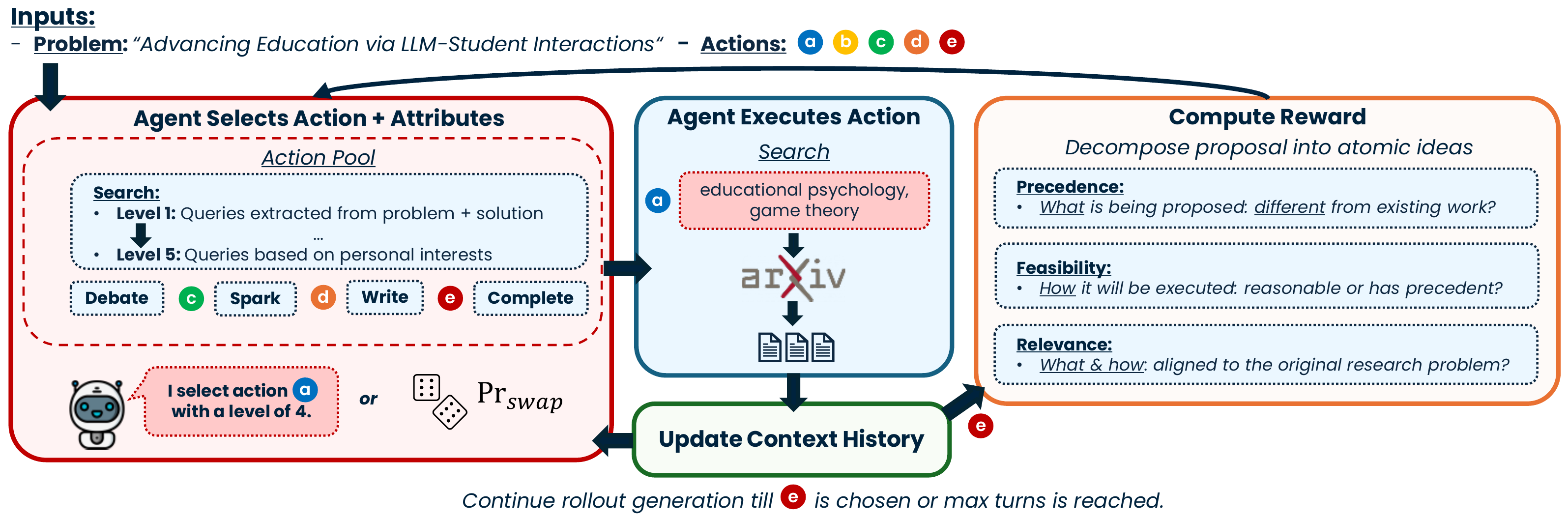
RL, same actions, no creativity levels
Adapt lectures in real time using a multimodal engagement scoreWhy green: a concrete new artifactOne score that fuses visual, auditory and physiological signals. It’s specific, measurable, and something later phases can build on. built from visual, auditory and physiological signals, fed into an RL engine that tunes pacing and content granularityWhy red: underspecifiedThe state, action and reward spaces are never defined, so it’s unclear how engagement signals actually become adaptation decisions.. Validated with a 120-person A/B study.
+ A concrete novel artifact and a controlled experiment.
− The core method is vague relative to the elaborate evaluation.
Takeaway: one new building block inside a fairly standard plan.
Night-8B (Rout)
Ours · outcome reward
Propose Agentify, which turns passive lectures into live, agent-mediated sessionsWhy green: a reframingRather than optimizing a recording after the fact, the lecture becomes a live, co-created session where an AI interleaves questions, hints and dialogue based on learner behavior.. A study randomizes 200 learners across 40 lectures into passive, over-moderated, fixed-tier and adaptive-tier groups, and includes a forced speed slider with eight settings (1×–8×)Why red: contrived detailThe rationale for this component is weak, and the related idea of co-evolving agent templates with “cognitive tiers” is underdeveloped..
+ Novel framing, testable hypothesis, sensible multi-group design.
− A few components are loosely motivated.
Takeaway: asks “what if a lecture were a conversation?” Bold, but still testable.
Night-8B (Rpo)
Ours · process + outcome
Propose Progressive Content Enactors: agents that deliberately embed controlled errors and ambiguityWhy green: the most novel directionPurposeful mistakes become a teaching tool, much as working through a flawed proof teaches more than reading a perfect one. It echoes error-based learning and productive failure, yet is clearly distinct from prior lecture systems. so learners must detect and resolve them, moving from passive reception to active problem solving. The background cites an engagement score of c = 0.12, +3.5σ retention and a 2.78σ efficacy gainWhy red: overreachNone of these numbers is independently verifiable or tied to a standard evaluation framework, which undermines the proposal’s credibility..
+ A fresh, actionable concept clearly differentiated from prior work.
− Unverifiable metrics and a weakly grounded evaluation.
Takeaway: the boldest idea and the least grounded. Scoring every step pushed originality at the cost of rigor.
Reading the comparison
Baselines improve the recording. GPT-4.1 and ReAct add better segmentation, pacing or sensing. The lecture is still something you watch.
Ours changes the premise. Both variants drop the idea that a lecture is passive. It becomes a conversation, or a puzzle to solve.
Bolder isn’t always better. The step-scored variant is the most original and the least rigorous. That is why outcome-only training is our default.